
We humans are a brilliant, imaginative, and resourceful lot. Yet we are also deeply stuck in our fear of change and the belief that serving self-interest first automatically serves the common good. History shows that major shifts only happen following major shocks, major investments only happen for profit, and societies only embrace structural transformation under the force of crisis.
The Deep Green Energy Project begins with a simple premise: any viable solution for the world’s predicament must anticipate hard physical and financial realities rather than wishing for miraculous changes in human behavior. To succeed at planetary scale, a solution must be globally deployable, immediately affordable and commercially profitable.
So let’s examine the roots of our predicament and how the Dynamic Deep Green engineering pathway can get us out of the hole before the walls cave in.
The IMF, World Bank, major insurance and actuarial firms, the IPCC, MIT, PwC, central banks, global risk analysts, and many of their counterparts are warning that "World Inc." is heading toward simultaneous ecological and financial insolvency.
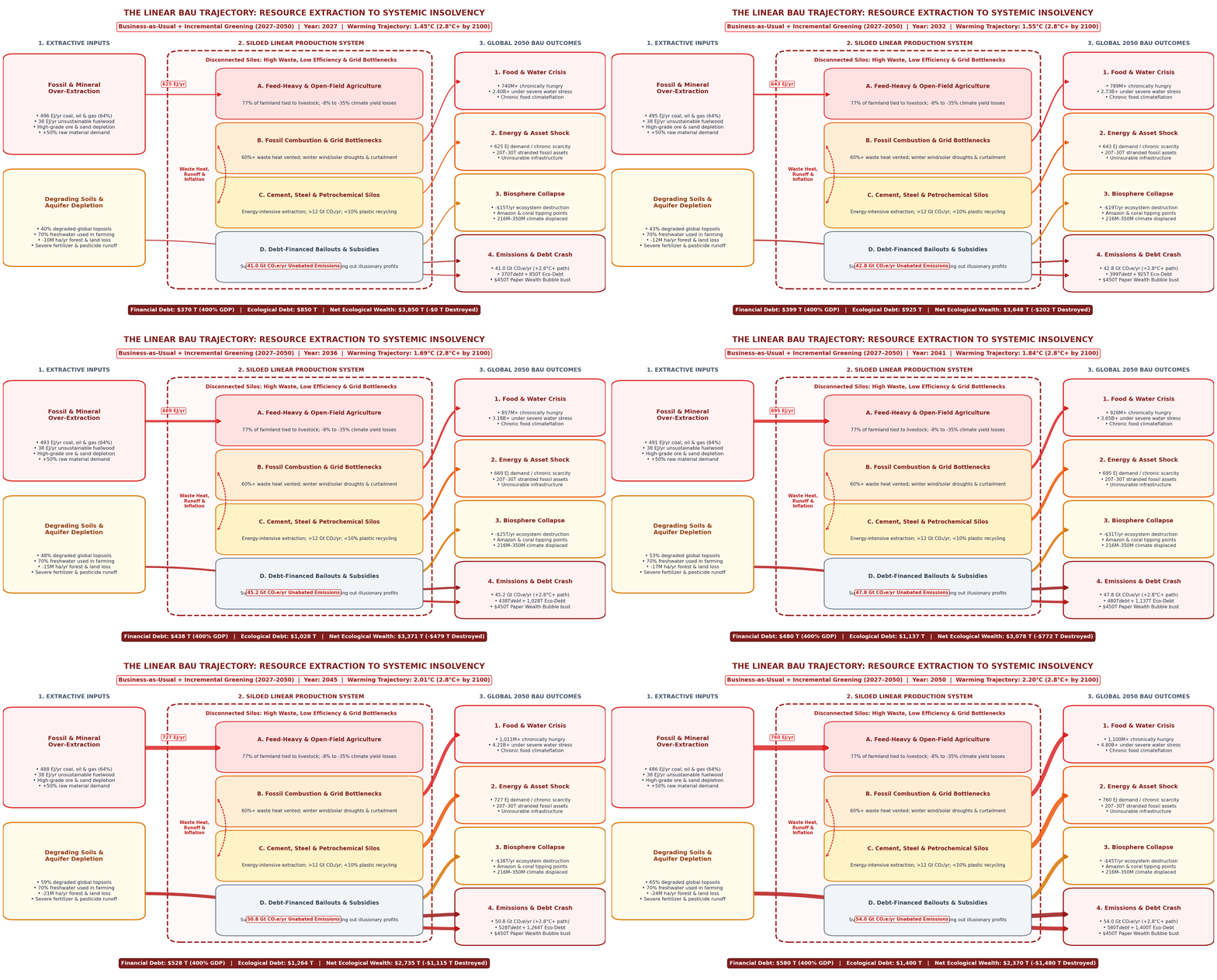
On our BAU Scenario Page, we audit the global economy using both Standard Financial accounting and Ecologically Extended Accounting exposing the four interlocking crises hidden behind traditional GDP growth:
- The Biophysical Predicament:
40% degraded topsoils, collapsing freshwater aquifers, and accelerating climate shocks slashing food yields by
-8% to -35% just as global demand rises by
+35% to +50%.
- The Financial-Economic Predicament: A global economy running an operating loss (-$5.12T in FY 2026) beneath a
$370 trillion debt mountain and a
$450 trillion paper wealth bubble detached from physical reality waiting to burst.
- The Ecological-Economic Predicament:
$850 trillion in accumulated Ecological Debt since 1970, masked by omitting
$15 trillion/year in natural capital destruction from corporate and national balance sheets.
- The Social & Geopolitical Predicament: 1.1+ billion people facing chronic hunger, 4.8 billion under severe water stress, and 216–350 million climate-displaced citizens, rising cost of living, crunching purchasing power, triggering sovereign defaults, instability and conflicts.
- The Systemic Insolvency Predicament: Taken together, these four compounding deficits lock "World Inc." onto a guaranteed path toward systemic insolvency where depleted physical assets can no longer service financial liabilities, and the core systems sustaining civilization face simultaneous collapse.
The Efficiency Imperative: Why proposed Incremental Fixes to our Critical Supply Systems Fail
By 2050, feeding, watering, and powering nearly 10 billion people while keeping global warming below 2°C demands a structural leap that featuring “green” policies cannot deliver:
- 400% – 600% Increase in Resource-to-Produce Efficiency: Producing 50% more nutrition and clean energy while shrinking agricultural land and freshwater consumption.
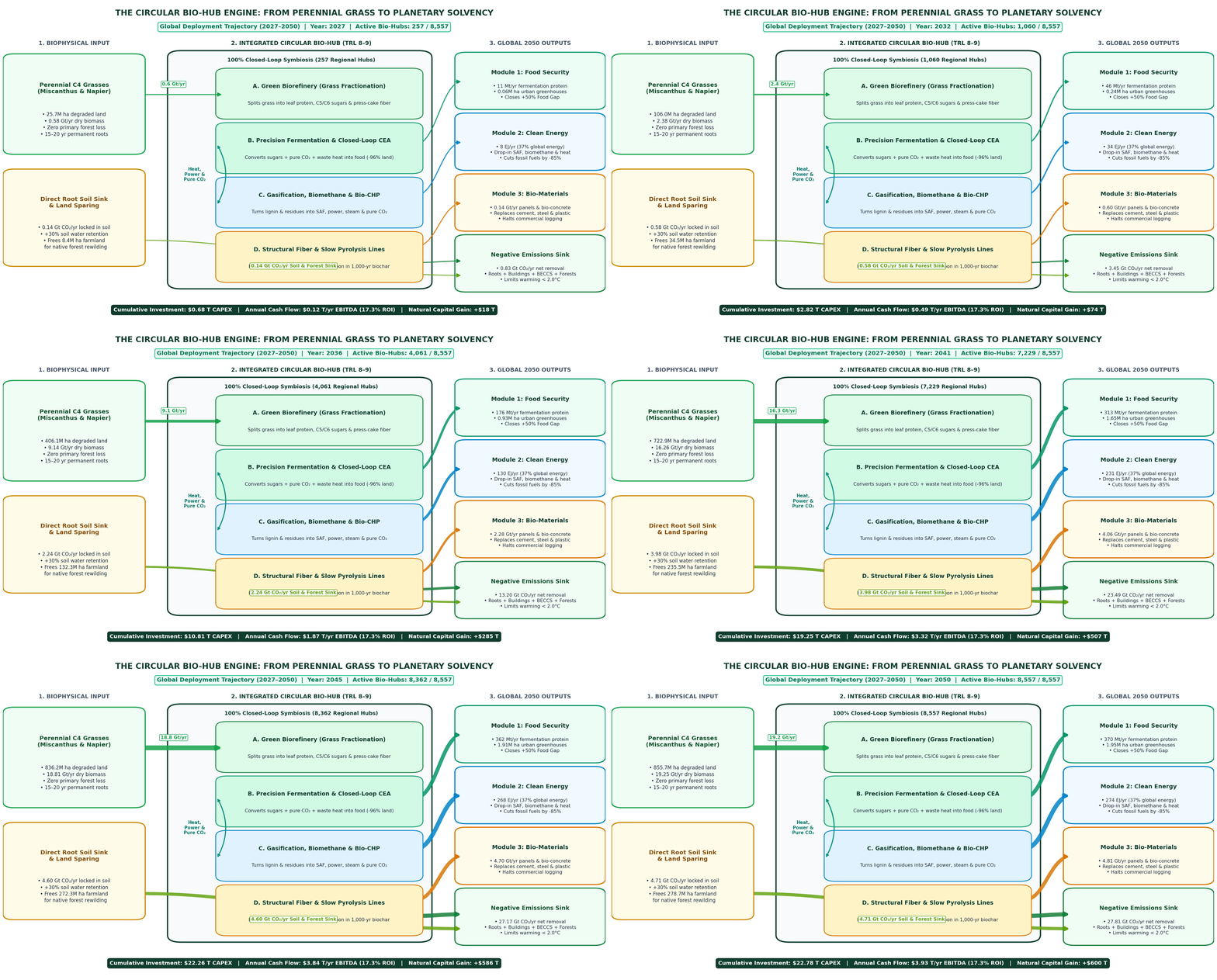
- 500% Increase in Time-to-Atmospheric GHG Reduction Efficiency: Removing 27.81 Gt of CO₂ per year at industrial speed rather than waiting decades for slow-growing timber plantations or carbon capture technologies to mature.
- 75% Reduction in Overall Planetary Footprint: Halting topsoil collapse, aquifer depletion, and deforestation while restoring 278.7 million hectares of native ecosystems.
These targets lie far beyond the theoretical maximum efficiency of our current industrial and agricultural systems. Under Business-as-Usual (BAU), resource extraction and emissions remain locked on a
+50% growth trajectory, pushing global warming toward
2.8°C+ by 2100 as vital ecosystems collapse beneath the populations that depend on them.
Instead of fighting human nature with austerity and rationing, the Deep Green Economy pairs AI-driven productivity with TRL 8–9 biogenic technologies to hit all three efficiency thresholds simultaneously. By cultivating fast-growing perennial C4 grasses (Miscanthus and Napier grass) across 855.7 million hectares of degraded land and processing them inside 8,557 decentralized circular Bio-Hubs, DGE unlocks a self-financing transformation:
- Availability & Supply Security: Secures 100% of +50% global food, water, and clean energy demand by 2050 without clearing a single hectare of forest or stranding existing energy grids.
- Affordability & Commercial ROI: Requires $22.78 trillion in total CAPEX (~$0.95T/yr)—generating $3.93 trillion/yr in EBITDA (17.3% average ROI and a 5.8-year payback) and enables AI to scale globally on abundant, low-cost clean baseload power rather than colliding with energy and grid bottlenecks.
- Wealth & Solvency Restoration: Caps global debt at $360 trillion, restores positive net income (+$4.28T traditional / +$9.28T ecologically extended), and adds +$600 trillion to Earth’s Natural Capital Balance Sheet and saves most of wealth and debt bubbles from bursting.
- Below 2°C Climate Stabilization: Captures
27.81 Gt CO₂/yr through permanent root soil carbon, durable biogenic building materials, and Bio-CHP carbon capture—halting further natural capital loss.
- New Title
Deep-Dive into the Five Deep Green Energy Modules
Food & Nutritional Security
Closes the +50% Food Gap using Precision Fermentation (TRL 8–9) and Closed-Loop Greenhouses with -96% less land and -90% less water.
Energy & Bio-Refining
Cuts fossil fuels by -85% without grid collapse. Perennial C4 grasses supply 37% of global energy via drop-in SAF, biomethane & Bio-CHP.
Materials & Regeneration
Turns buildings into an 8.66 Gt CO₂/yr carbon vault while rewilding 278.7M ha of native forest and healing 855.7M ha of degraded soils.
Social & Regional Stability
Prevents the $450T paper wealth bust, sovereign defaults, and mass climate migration across six global regions.
Circular Bio-Hubs & Reserves
8,557 decentralized circular Bio-Hubs (Wave 1: TRL 8–9) backed by Wave 2 Strategic Reserves (HTL, SMRs, DAC & e-Fuels).